We are currently updating this website. The Digital Legacy Conference programme will be announced in full in the coming weeks.

We are currently updating this website. The Digital Legacy Conference programme will be announced in full in the coming weeks.
We have agreed a time, place and venue for next year’s conference…. We will have a call for speakers and announce more details in early 2019.

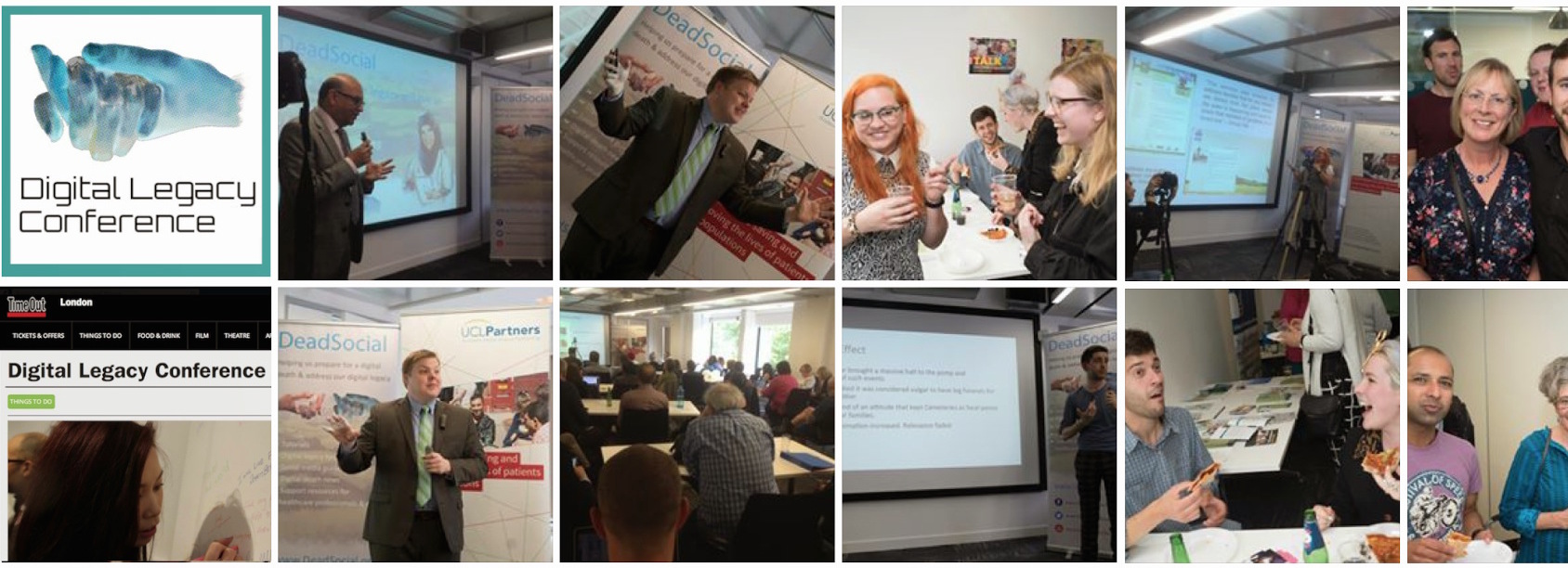
Thank you for all those who spoke, supported and attended this year’s Digital Legacy Conference. More details, photos and videos will be published in late November.
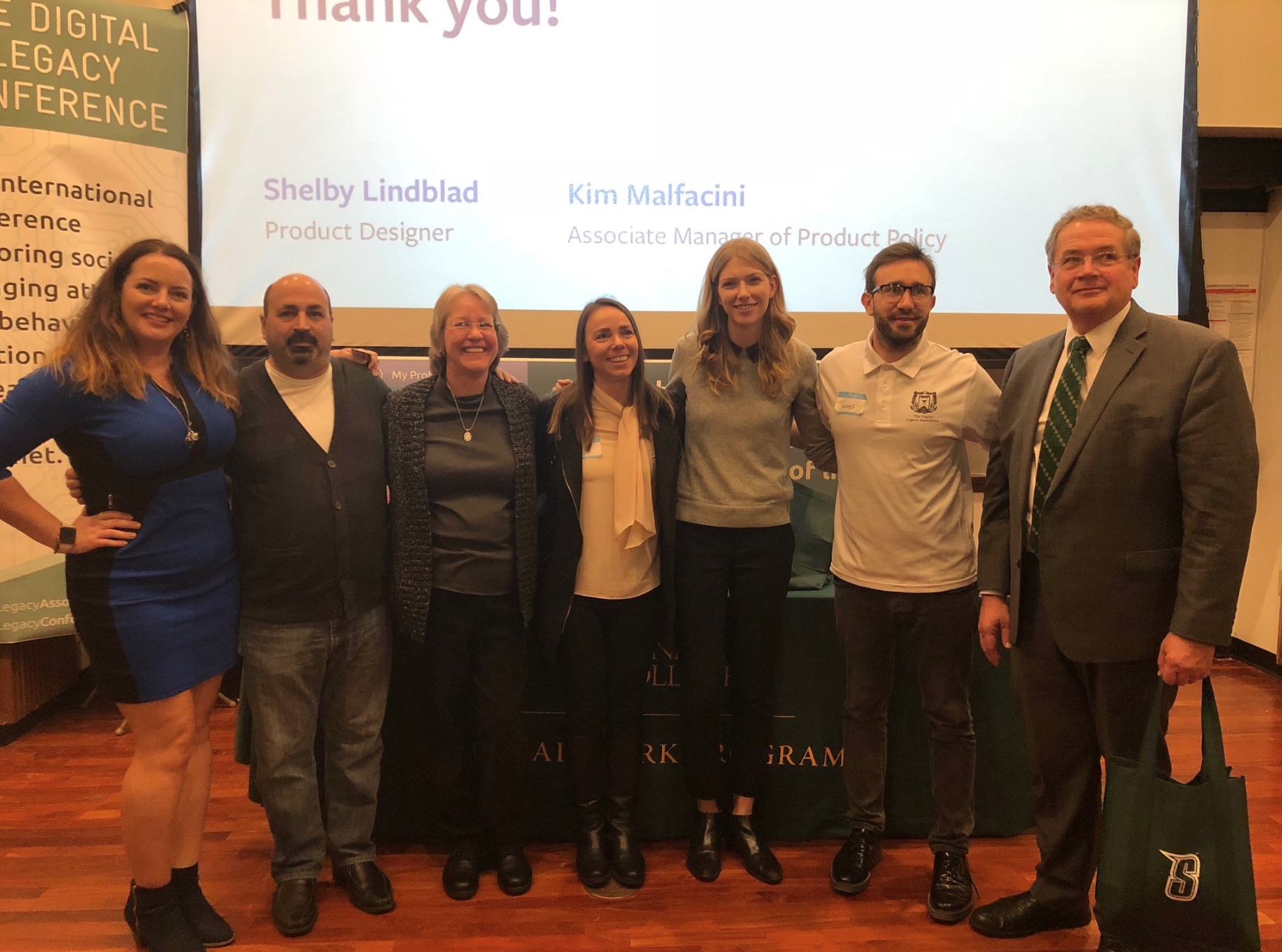

This year The Digital Legacy Conference will welcome a diverse range of speakers from a multitude of different professions. The objective of the Digital Legacy Conference is to improve conversations and to both inspire and support professionals to better serve the needs of their clients, users, patients, loved ones and the bereaved.
“Please join us to learn about how technology is changing the way our society deals with impending death, loss, and grief from legal, funeral-related, psychological, and social perspectives”.
– Dr Carla Carla Sofka, Ph.D., MSW Professor of Social Work, Siena College
We are delighted to announce that this year’s keynote will be delivered by Shelby Lindblad (Product Designer at Facebook) and Kim Malfacini (Associate Manager of Product Policy at Facebook). Together they will explore the policy and product design behind Facebook’s Memorialization and Legacy Contact capabilities.

Shelby Lindblad is a Product Designer at Facebook working on issues related to memorialization. Prior to joining Facebook, she worked at Method, a global design firm with clients such as Google, HP, and the San Francisco Ballet. Her work has been recognized by Fast Company and the A’ Design Awards. Shelby graduated with a BFA in Communication Design from Washington University in St. Louis.
Kim Malfacini is Associate Manager of Product Policy at Facebook, the team responsible for developing Facebook’s Community Standards governing what is and is not allowed on the site. Kim focuses on stakeholder engagement, ensuring Facebook’s policies are informed by experts across the globe. Prior to joining Facebook, Kim served as Director of Public Policy for Sunrun Inc., the largest residential solar energy provider in the US, where she advocated for the rights of residential energy producers with state legislators and regulators. She spent two years in Benin with the United States Peace Corps, leading projects in environmental health and young women’s empowerment. Kim graduated Phi Beta Kappa from the University of California Los Angeles with a Bachelor of Arts in Global Studies.
“We look forward to welcoming Shelby, Kim and all of this year’s speakers, sponsors and guests to Siena College on Saturday. This is the first time that the Digital Legacy Conference will take place out of Europe and are expecting it to be the best one to date”.
– James Norris, Founder Digital Legacy Association, DeadSocial & The Digital Legacy Conference.
To view the full agenda and reserve a free ticket visit https://DigitalLegacyConference.com/speakers

20 years ago the Institute of Medicine stated that a good death is one that is “free from avoidable distress and suffering for patient, family, and caregivers, in general accord with the patient’s and family’s wishes, and reasonably consistent with clinical, cultural, and ethical standards.”
At this year’s Digital Legacy Conference we will examine how this statement can tranced across the technological divide as professionals, technologists and academics explore these areas within a digital context.
We are delighted to welcome Shelby Lindblad (Product Designer at Facebook) and Kim Malfacini (Associate Manager of Product Policy at Facebook) as this year’s keynote speakers. To read the full agenda click here
The Digital Legacy Conference is an international, not for profit conference ran by the Digital Legacy Association. The conference brings together professionals, educators, patients, researchers and those with working within relevant fields in a melting pot of creativity, science and social care. The Digital Legacy Conference celebrates innovation, best practice, research and thought leadership within digital assets, digital estates and digital legacy.
We are delighted to announce that this year’s Digital Legacy Conference will take place at Siena College in Albany New York. The conference is also featured as one of the many ‘Reimagine End Of Life. Reimagine End of Life explores big questions about life and death between the 27th – 3rd November.


We have put together a press release for this year’s Digital Legacy Conference. Feel free to copy and paste the copy onto your website. Alternatively download the text (as a .doc) and use the images provided when referencing the Digital Legacy Conference. If you download the press release it will save as a .ZIP file. simply open it and use the media provided. To download the press release click here.
We are spending an increasing amount of our lives online. The sentimental and monetary value of the content we upload, share and purchase is increasing year on year….But what happens to our online world when we die?
The Digital Legacy Conference explores societies attitudes and behaviours around death, dying, bereavement and the internet. This annual conference is ran by the Digital Legacy Association who operate from London. This year’s conference will examine how a variety of professions such as the legal, social care, healthcare and funeral care are changing their practice in order to better support the general public. This year’s conference will share best practice and recent research whilst asking questions about how these areas can improve and evolve.
On the 27th October 2018 the Digital Legacy Conference will take place at Siena College, Albany New York. This will be the first time that the conference has taken place outside of Europe and the Digital Legacy Association are looking forward to working with Siena College’s social care department to address this increasingly important area.
Siena College is a private, co-educational liberal arts college in the Franciscan and Catholic tradition. Siena is committed to offering the Education for a Lifetime for a new generation of leaders eager to create a more just, peaceful and humane world.
The Digital Legacy Conference call for speakers is now open. Those with relevant professional experience, case studies, research or stories should apply to participate at: http://www.digitallegacyconference.com/speakers
We also encourage policy makers, technologists, the legal sector and all those who support the general public with estate planning, palliative care, bereavement and end of life to attend.
More information and free tickets to attend the conference can be reserved at: www.DigitalLegacyConference.com

The call for speakers and papers is now open for academics and professionals working and innovating within relevant fields. If you would like to submit a paper and speak at this year’s Digital Legacy Conference please fill in the form below.
Some of the subject matters you may want to address?
⇝ Digital death and it’s impact on society
⇝ Digital legacy, digital assets and digital estates
⇝ Grieving online
⇝ Digital graveyards,
⇝ Utilising technology to deal with death
⇝ Digital memory loss
⇝ Death in today’s digital world
⇝ Funeral streaming
⇝ Laws and terms of service around digital assets and digital legacy
⇝ Preparing for our own digital death
⇝ Artificial Intelligence and death
⇝ Robotics and death
⇝ Death, Cryptocurrency and other digital financial assets
⇝ Death and Virtual Reality
⇝ Whats next?
⇝ Best practice
⇝ Diffusion of information and adoption
⇝ The patients perspective
⇝ The role of the professional
Do you have another idea? Inspire us!
Applicants will be informed by email whether or not their application has been successful in September.
About the Digital Legacy Conference
The Digital Legacy Conference is an International Conference by the Digital Legacy Association. The objective of the Digital Legacy Conference is for professionals and academics working with in the field to share knowledge, best practice, case studies and stories. The conference is free for attendees due to the support provided by the sponsors: www.DigitalLegacyConference.com
About the Digital Legacy Association
thee Digital Legacy Association is the professional body dedicated to raising the quality of end of life care in all areas relating to digital assets, digital estates and digital legacy. Our mission is to help ensure that everyone’s end of life wishes are met both in the real world and the digital realm. We do this by supporting the general public, by developing standards, frameworks and toolkits with charities and third party organisations.

As part of Commentary’s special feature on end-of-life care, James Norris, founder of the Digital Legacy Association, examines how a patient’s digital footprint is an increasingly common part of advance care planning.
The internet has been the biggest catalyst for change since the industrial revolution. It has changed the ways in which we consume and share information and, in doing so, the ways in which we interact with one another has changed forever. Recent Ofcom statistics reveal that adults in the UK now spend on average 22.9 hours a week online, with those aged 16–24 spending 35.2 hours a week online.
While online, many share personal thoughts, photos and videos on social media sites such as Facebook, Twitter, Instagram, etc. Prior to the internet, photos and videos existed only as physical assets (eg as photo albums, photo frames, video cassettes etc). Now, social media and connected devices (like mobile phones) allow these assets to be uploaded and shared online (often referred to as ‘in the cloud’). This allows conversations to break free of previous constraints and take place in real time. This enables friends and family members who may live many miles away to stay connected with their loved ones on a regular basis.
The Digital Legacy Association was launched three years ago at Hospice UK’s conference in Liverpool. It was apparent that people were not making suitable plans for their digital estate and that increased awareness, support literature, lobbying and training was required at a national level.
Upon death, the deceased person’s digital footprint (the digital information left online) and other media available about the deceased helps to form their ‘digital legacy’. For many people, the deceased’s digital legacy plays an important part in the mourning process. In the UK the deceased’s Facebook profile often becomes the main focal point to remember and share stories about a loved one.
Our Digital Death Survey indicates that the importance we place on our being able to view social media accounts following someone’s death is increasing year on year. For example, when respondents were asked: ‘If someone you care about were to die, how important would it be for you to be able to view their social media profiles?’ 45.2% of respondents replied ‘important’ or ‘very important’ in 2017, up from 37.3% in 2014.
The term ‘digital assets’ can refer to items such as music purchased through Apple, eBooks purchased through Amazon or photos and videos captured on mobile phone. It is increasingly important that the general public make plans for what should happen to their digital assets and their digital footprint in the event of death. Making suitable plans can help ensure sentimental photos, videos and documents are still accessible and not lost upon death. Pre-planning can also ensure that assets that are of monetary value, such as business files and purchased media, are still accessible.
Our research shows that most people are not making sufficient plans and as a result their digital assets – those of sentimental and monetary value – are being lost. When questioned in our surveys, 97% of respondents had made no plans to protect their digital assets.
It is important that healthcare and social care professionals speak with patients about their digital lives when having advance care planning conversations. For some people, simply telling a loved one the password for their mobile device before losing the ability to do so may be a suitable plan. However, more regular users of technology (who may use social media, gaming or have money stored and spent in PayPal, eBooks, music libraries etc) may prefer to document their wishes in a social media will.
Our research indicates that the sentimental value placed on people’s digital legacy will continue to increase each year. While working for the Digital Legacy Association, I have often received the feedback that these issues are ‘very important for the younger generation’. Although we fully agree with this statement, one in four people over the age of 65 in the UK say that they are active on social media (Office for National Statistics 2016), and so we argue that digital asset and digital legacy planning is an important area for everyone regardless of age, religion, gender or creed.
James Norris is the founder of the Digital Legacy Association, a professional body dedicated to raising the quality of end-of-life care in all areas relating to the proection of digital assets and digital legacy.
We are delighted to announce that this year’s Digital Legacy Conference will take place in the USA. More details to come.